
Jewelry guide
How Much Is My Diamond Ring Really Worth?
Your insurance appraisal says $8,400. No buyer in any city will pay it — and that's not a trick. Here's the honest explanation.
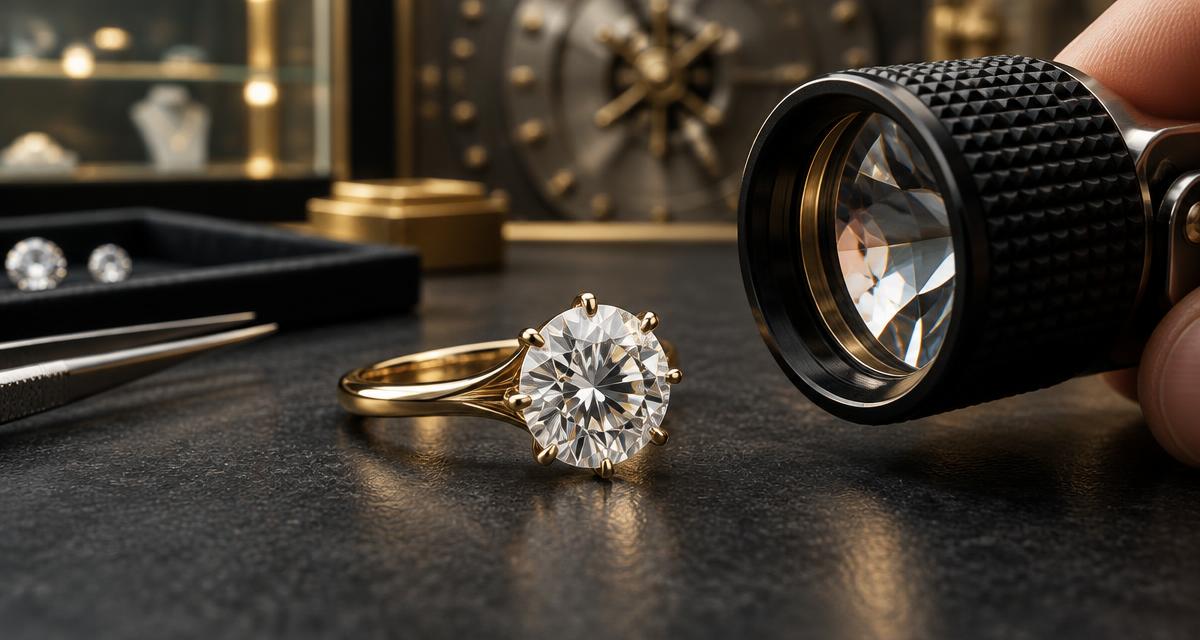
The hardest conversation in this business is the one about diamond rings, because there's usually a gap between what someone paid, what the appraisal says, and what anyone will actually hand them in cash.
We'd rather explain that gap honestly than dance around it.
The appraisal is not the selling price
Your insurance appraisal says $8,400. That number exists so that if the ring is stolen, your insurer will pay to replace it at full retail from a jewelry store, including that store's markup and overhead.
It is a replacement-cost document. It was never meant to be a resale estimate, and no buyer in any city will pay it.
This is not a trick being played on you — it's just two different numbers answering two different questions. Knowing that before you walk in saves a lot of disappointment.
What actually determines a diamond's resale value
Diamonds are priced on the familiar four Cs, and each one moves the number substantially:
Carat weight. Not just size — value rises sharply at the round numbers. A 1.00ct stone is worth considerably more than a 0.95ct, out of proportion to the weight difference, because of how the market prices thresholds.
Cut. The single most visible factor. An excellent cut stone throws light back at you; a poor cut looks dull even at high clarity. Cut quality drives price hard.
Color. Graded D (colorless) through Z (noticeably tinted). D–F is colorless, G–J near-colorless, and it drops from there. Most engagement rings sit in the G–J range.
Clarity. Flawless down through VVS, VS, SI, and I (included). Inclusions visible to the naked eye — the I grades — reduce value significantly.
Then two more things that matter as much as any of the four:
Certification. A GIA or IGI report removes all doubt and typically raises the offer, because the buyer isn't pricing in uncertainty. If you have the paperwork, bring it.
Lab-grown vs natural. This one is worth being blunt about: lab-grown diamonds have fallen dramatically in value and continue to. A lab-grown stone is worth a small fraction of a natural stone of identical specifications. If your ring was bought in the last several years, it's worth knowing which you have — and we'll test and tell you.
The setting is valued separately
A ring is two things: stones and metal. We value them independently and add them together.
The mounting is weighed as gold or platinum at its karat — a 14K solitaire mounting is usually 2–5 grams, a wide men's band 10–14 grams, platinum heavier still. That's a real component of the offer, particularly with gold where it is now.
Side stones and accent diamonds are counted into the total carat weight too. Halo settings and pavé bands add up.
Why the offer is below what you paid
Three reasons, and they're structural rather than personal:
- Retail markup. New jewelry carries a large margin. That margin doesn't come back when the ring changes hands.
- The buyer takes the resale risk. We have to hold the piece, insure it, and find a buyer at a price that works. That risk is priced in.
- The pre-owned diamond market is its own thing and moves independently of retail sticker prices.
Every buyer in Metro Detroit faces the same three realities. Anyone promising you retail value for a used ring is telling you what you want to hear.
How to get the best number
Bring the certification. GIA and IGI reports raise offers. So do original receipts and appraisals — not because we pay the appraised figure, but because they establish exactly what the stone is.
Bring the box and papers. For designer pieces especially, a complete set matters.
Don't clean or "improve" it. A jeweler's ultrasonic is fine; DIY repairs and re-polishing are not.
Get more than one offer, in writing. Diamond valuation involves more judgment than gold does, so offers vary more between buyers. This is the category where a second opinion genuinely pays. Bring us the best written number you get and we'll try to beat it.
Ask how they arrived at it. A real buyer will show you the stone under the loupe and walk you through the grade they've assigned. If the answer is just a number with no explanation, keep shopping.
Consider pawning instead
This comes up constantly with engagement rings, and it's often the right answer.
A ring from a marriage that ended, or a family piece you're ambivalent about, doesn't have to be a permanent decision. Pawn it: you get cash today, the ring goes into our vault insured, and it's yours again when you repay. If you decide later that you're done with it, you simply don't redeem it — and there's no credit check and no credit reporting either way.
A lot of people use that as a deliberate trial period.
Selling loose diamonds
If you have a stone out of its setting — inherited, or removed during a remount — the process is the same but cleaner, since there's no metal to separate out.
Bring any certification. Uncertified stones are graded at the counter under a loupe and priced accordingly, which usually means a slightly more conservative number than a certified equivalent, simply because the buyer is absorbing the uncertainty.
What to expect at our counter
We look at the stone under magnification while you watch. We measure or weigh it, assess cut, color and clarity, test whether it's natural or lab-grown, check for chips or damage, then weigh the mounting separately. We explain each part of the number.
You're free to take it home, think about it, get three more opinions and come back next month. Nothing about a diamond is urgent.
What we buy that's mentioned here
Keep reading
Jewelry6 min read
Inherited Jewelry, Coins or Tools? How to Get Cash Fast in Westland
A practical way to sort inherited valuables, understand a cash offer, and choose the right outlet for the rest of a household.
Read the guide →
Gold8 min read
How to Get the Most Money for Your Gold in Metro Detroit
Most people sell gold once or twice in their life. The person buying it does it fifty times a day. Here's how to close that gap.
Read the guide →Gold7 min read
What Is Scrap Gold Actually Worth? A Straight Answer
"Scrap gold" sounds like an insult. It isn't — and broken gold is worth exactly the same per gram as unbroken gold.
Read the guide →