
Coins guide
How to Sell Silver Coins Without Getting Shorted
Sell a 1916-D Mercury dime for its silver content and you've just handed someone a few thousand dollars. Here's how not to let that happen.
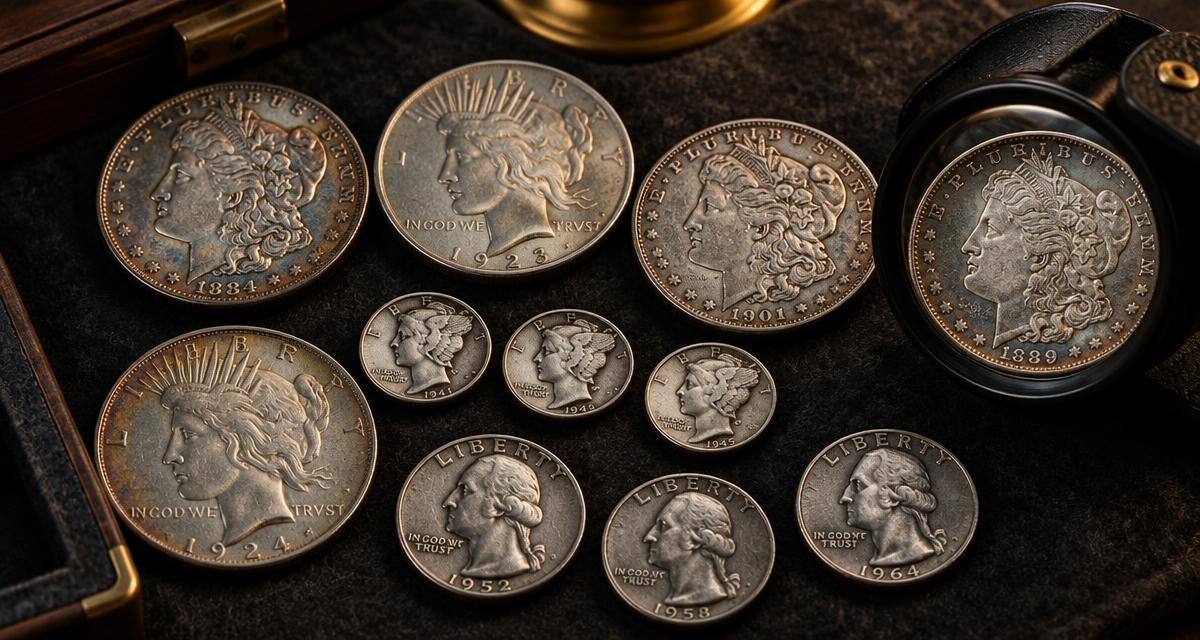
Silver coins are the one category where the difference between a good buyer and a careless one can be enormous — because a coin's value often has nothing to do with how much silver is in it.
Sell a 1916-D Mercury dime for its silver content and you've just handed someone a few thousand dollars. It happens. Here's how not to let it.
First: which of your coins are actually silver?
What we're paying today
- 10KCall for today's price
- 14KCall for today's price
- 18KCall for today's price
- 22KCall for today's price
- 24KCall for today's price
- Sterling silver (.925)Call for today's price
- Fine silver (.999)Call for today's price
- Platinum (.950)Call for today's price
Prices update daily. Final offer confirmed in store after testing and weighing.
The date does almost all the work.
90% silver (the good stuff):
- Dimes, quarters and half dollars dated 1964 or earlier
- Silver dollars: Morgan (1878–1904, 1921) and Peace (1921–1935)
40% silver:
- Kennedy half dollars dated 1965–1970
35% silver:
- "War nickels" — Jefferson nickels dated 1942–1945 with a large mint mark letter above the Monticello dome. These are the ones people spend without realizing.
Not silver:
- Any dime or quarter dated 1965 or later
- Kennedy halves 1971 and later
- All pennies (though wheat cents have their own collector value)
- Standard Jefferson nickels outside the war years
The edge trick: stand a stack of coins on its side and look at the rim. Silver coins show a solid white-grey edge. Modern clad coins show a copper stripe. It's instant and reliable.
What "junk silver" means (it isn't junk)
"Junk silver" is trade shorthand for common-date 90% silver coins with no collector premium — they're valued purely on their silver content. It's the easiest silver in the world to buy and sell because the math is known and exact.
A useful figure: $1 of face value in 90% silver coins contains about 0.715 troy ounces of silver. So $10 face (a standard bag) holds roughly 7.15 ounces.
That means the coin's face value is nearly irrelevant — a 1964 quarter isn't worth 25 cents, it's worth its silver.
The coins that are worth far more than their silver
This is why you should never sell a coin collection by the pound.
Key and semi-key dates to look for:
- 1916-D Mercury dime — a genuine rarity, worth hundreds to many thousands in any condition
- 1909-S VDB Lincoln cent — hundreds even heavily worn
- 1914-D and 1922 plain Lincoln cents
- 1937-D three-legged Buffalo nickel
- Carson City (CC) Morgan dollars — any of them, and 1889-CC especially
- 1893-S Morgan dollar — the king of the series
- 1921 high-relief Peace dollar
- Pre-1934 Walking Liberty halves, especially 1916–1921
- Any coin in uncirculated condition, which can be worth multiples of a worn example
Several of these are also heavily counterfeited, which is exactly why they need to be authenticated by someone who handles them regularly rather than sold in a pile.
The one mistake that destroys value permanently: cleaning
We need to be emphatic about this.
Do not clean your coins. Not with polish, not with a cloth, not with baking soda, not with a pencil eraser, not with anything.
The dark toning on an old silver coin is original surface, and collectors pay for it. Cleaning leaves microscopic scratches that are obvious under magnification and instantly identifiable. A cleaned coin can lose 50% or more of its collector value, and the damage cannot be undone.
We've had customers arrive having spent an evening polishing grandpa's silver dollars to a bright shine, genuinely trying to help, and there's nothing anyone can do about it afterward.
Bring them dirty, dark and toned. That's how they're supposed to look.
Don't sort, organize or "tidy" the collection either
Related advice: leave albums, folders and original packaging exactly as they are.
- Original mint and proof sets are worth more sealed than opened.
- Coin albums tell us what's there and what's missing at a glance.
- Original rolls (the paper-wrapped kind) can carry a premium over loose coins.
- Slabbed coins should stay in their holders — the grade is the value.
Breaking a set apart to sell the "good ones" frequently reduces the total.
How a proper coin evaluation should go
When you bring coins to a buyer who knows what they're doing, expect:
- The collection is looked at coin by coin, not weighed in bulk
- Dates and mint marks are checked against the key-date list
- Bullion-value coins are separated from collector coins
- You're told what each group is and why
- Anything unusual is flagged even if you weren't asking about it
If someone reaches for a scale before they've looked at the dates, that's your signal to stop and go elsewhere.
Where the mint mark is on each coin
Helpful to know before you walk in:
- Morgan and Peace dollars: reverse, below the eagle (Morgan) or near the tail feathers (Peace)
- Mercury dimes: reverse, left of the fasces base
- Walking Liberty halves: obverse below the motto on 1916–17, reverse lower-left afterward
- Lincoln cents: obverse, below the date
- War nickels: large letter above the Monticello dome on the reverse
- Buffalo nickels: reverse, below "FIVE CENTS"
CC means Carson City and always deserves a second look.
Should you get coins graded first?
For most collections, no.
Professional grading (PCGS, NGC) costs money per coin plus shipping and insurance, and it only pays off when the coin is scarce enough or high-grade enough that certification adds more value than it costs.
The sensible sequence: bring the coins in raw first. A good buyer will tell you honestly which coins — if any — are worth submitting for grading, and which are simply silver. Then you can decide.
Selling an inherited collection you know nothing about
This is most of the collections we see, and it's a perfectly normal situation.
- Bring all of it, including the parts that look like loose change
- Don't pre-sort or clean anything
- Ask the buyer to walk you through it — a real one will, at no charge and with no obligation
- You can always take it home and get a second opinion. We encourage it.
- You don't have to sell the whole thing. Sell the bullion, keep the album. That's a completely reasonable outcome.
What to bring
- All the coins, exactly as they are
- Any albums, folders, tubes, slabs, receipts or old appraisals
- A valid state ID
Evaluation is free and there's never an obligation to sell. Being twenty minutes from the Windsor border, we handle Canadian silver constantly too — pre-1967 Canadian coinage is 80% silver and we buy it every week.
What we buy that's mentioned here
Keep reading
Jewelry6 min read
Inherited Jewelry, Coins or Tools? How to Get Cash Fast in Westland
A practical way to sort inherited valuables, understand a cash offer, and choose the right outlet for the rest of a household.
Read the guide →
Gold8 min read
How to Get the Most Money for Your Gold in Metro Detroit
Most people sell gold once or twice in their life. The person buying it does it fifty times a day. Here's how to close that gap.
Read the guide →Gold7 min read
What Is Scrap Gold Actually Worth? A Straight Answer
"Scrap gold" sounds like an insult. It isn't — and broken gold is worth exactly the same per gram as unbroken gold.
Read the guide →